Google's AI answers are taking the clicks. Here's how to get cited instead.
[AUTHOR NAME]
[ROLE]

Key takeaways
- Ranking first no longer guarantees a click when an AI answer sits above your listing.
- AI engines cite pages that answer directly, show expertise, and are mentioned on trusted sites.
- You can measure and grow AI visibility the same way you track keyword rankings.
What AI Overviews and AI Mode actually are
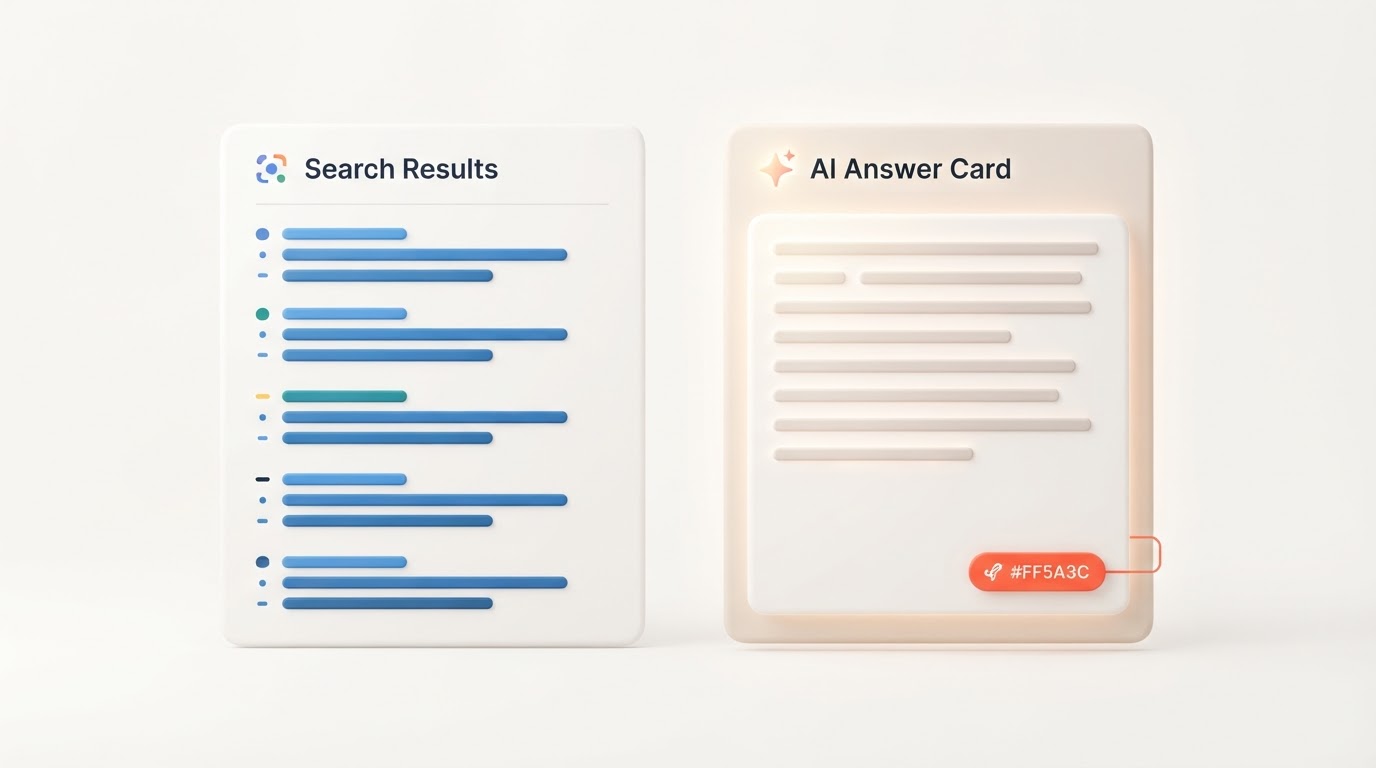
When you search Google today, you often see an answer before you see any blue links. That block is the AI Overview. Google reads pages across the web, writes a summary, and shows it at the top. AI Mode takes this further: it reasons across searches and can answer a whole question without sending you to a site at all.
This is a real change in how search works. For ten years, the goal was to rank high so a click would follow. Now a high rank can sit underneath an AI summary that answers the question for the reader. The click you earned by ranking no longer arrives.
Why rankings alone no longer guarantee clicks
The numbers tell the story clearly. Seer Interactive found that organic click-through rate on informational queries with AI Overviews fell 61% since mid-2024, and paid CTR on those queries fell 68%.
Ahrefs analysed 300,000 keywords in February 2026 and found AI Overviews correlate with a 58% lower CTR for top-ranking pages. Pew Research found that 8% of users click a traditional result when an AI Overview appears, versus 15% when it doesn't.
Read those together and the message is simple. When an AI answer shows up, fewer people click anything. The traffic that used to flow to the top result now stays on the results page. Ranking is still worth winning, but it is no longer the whole job.
Want this done for you? Get a free growth plan.
Answer 8 quick questions and a strategist sends your plan on WhatsApp.
Explore SEO and AI SearchHow to become a cited source
AI engines pick sources they can summarise and trust. They favour pages that answer a question directly, show real expertise, and are mentioned on other trusted sites. Vague marketing copy rarely gets cited. Specific, useful pages do.
Write direct answers
State the answer in the first line, then explain. AI models lift the clearest sentence. If your page buries the answer in the fourth paragraph, a competitor who leads with it gets cited instead.
Use FAQ pages and schema markup
Frequently asked questions match how people phrase searches, and how AI models frame answers. Add FAQ schema so engines can read the question and answer pair without guessing.

Show original data and expertise
Pages with original research, real numbers, and named experts get cited more often. If you have data from your own work, publish it. AI models prefer a source that can be checked over one that only offers opinion.
Be mentioned on trusted sites
Being cited inside an AI answer often follows being mentioned on trusted sites first. Press, industry publications, and directories still matter. They give the engines corroboration that your business is real and relevant.
Keep pages fast and clean
Slow, cluttered pages are harder for engines to read and harder for people to share. Speed is a baseline, not a bonus.
How to measure AI visibility
You can track AI visibility the same way you track keyword rankings. Ask the engines the questions your customers ask, and see whether your business appears in the answer.
Keep a short list of ten to twenty questions. Check them each month. Note whether you are cited, mentioned, or absent. Over time you will see which topics you own and which need work.
This is a new channel, so treat it like one. Give it a goal, an owner, and a regular review. The brands that start measuring now will be the ones that show up when the rest are still watching their old rankings slip.
Your 10-step checklist to get cited
- 1List the twenty questions your customers ask most.
- 2Check each one in Google AI Mode and note whether you appear.
- 3Write one page per question that answers it in the first line.
- 4Add FAQ schema to every answer page.
- 5Publish any original data you have, with a named author.
- 6Get listed on the directories and publications your buyers trust.
- 7Cut anything that slows your pages down on mobile.
- 8Use clear headings and short paragraphs so answers are easy to lift.
- 9Re-check your twenty questions each month and track movement.
- 10Link your answer pages to each other so engines see the cluster.
What to do this week
Pick the single question your customers ask most. Write one page that answers it in the first sentence, then explains. Add FAQ schema. Check it in AI Mode in a week. That is your first data point, and the start of a habit that compounds.
FAQs
Do I still need to rank on Google if AI answers exist?
Yes. Ranking still matters, especially for queries where no AI answer appears. But ranking alone no longer guarantees clicks, so the job now includes becoming a cited source inside AI answers.
How long does it take to get cited in AI answers?
It varies. Clear, well-structured answer pages can be picked up within weeks. Building the trust signals that make citation stick, like mentions on trusted sites and original data, takes longer.
Can I pay to be cited in AI answers?
No. AI engines choose sources based on relevance and trust, not payment. The way in is to publish useful, specific, well-structured answers and to be mentioned on trusted sites.
Sources
- Seer Interactive: organic CTR on informational queries with AI Overviews fell 61% since mid-2024, paid CTR fell 68%
- Ahrefs analysis of 300,000 keywords (February 2026): AI Overviews correlate with a 58% lower CTR for top-ranking pages
- Pew Research: 8% of users click a traditional result when an AI Overview appears, versus 15% when it doesn't
Want this done for you?
Get a free, personalised growth plan in 60 seconds, or talk to a strategist today.



Your next customers are already searching. Let's meet them first.
Get a free, personalised growth plan in 60 seconds, or talk to a strategist today.
Nothing to sign today. Replies within minutes in business hours.